Technology Accelerated The Affordability Problem
Even when it made things cheaper, technology made life more expensive

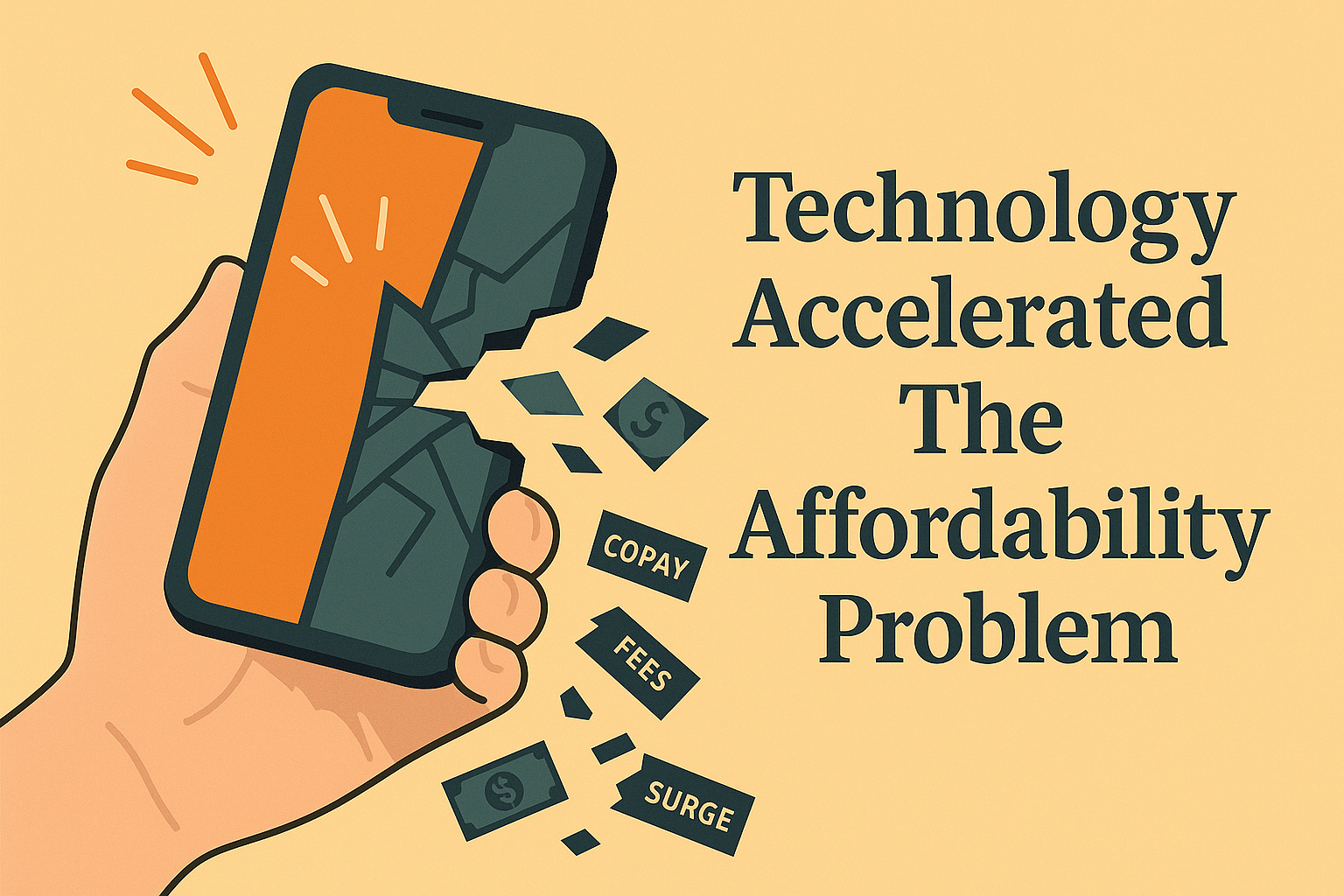
Right now, “affordability” seems to be everywhere. Voters in recent national surveys rank “the economy” at the top of the “most important problem” list, even as headline inflation cools. It’s the new master key for politics, used as a catch‑all for high prices and low mobility; groceries and rent, but also health care, education, housing, taxes, and a sense that the ladder itself moved out of reach.
But affordability politics did not appear only because prices rose. It emerged because, for almost the last half century, technology and innovation systematically atomized how we work, borrow, insure, and buy.
I define atomization as the ongoing slicing of society into smaller and smaller units, driven by relentless waves of innovation, like the commercial internet, cloud computing, logistics optimization, marketplace platforms, fintech, AI, and others.
Many innovations solved real problems for people. But each wave of innovation shaved friction for companies and platforms while splintering what used to be shared risk and bundled costs into little shards that now sit on individual households. Taken together, they accelerated rising wages, inflation, and a pushing down of risk from companies to individuals.
Innovation, and its corresponding atomizations, induced three related shifts that made life less affordable for most people:
Ways to push risk down onto individuals
Ways to meter and slice costs into more, dynamic little bills
Ways to move power and capital faster than our institutions could react
Risk
Mid 20th century America handled much of its people’s risk in big, boring pools. Large employers kept people on payroll through slow seasons; pensions promised defined benefits; group health plans spread sickness risk across big workforces; utility monopolies smoothed energy shocks.
Then, spurred on by the invention of the microchip, cheap mainframes and specialized record‑keeping software helped companies flip pensions into something more “flexible”: in the 1970s and 1980s, new tax rules created the 401k. Mutual fund companies and payroll processors built the pipes to track each person’s contributions, investment choices, and daily market returns. That shift required technology. A 1955 HR department could not have reconciled millions of individually customized retirement accounts by hand.
Then came the conceptual reframe: instead of firms promising a payout and bearing the investment risk, workers would “own” their retirement and bear the risk themselves. The spreadsheet era made it trivial to model how much a company saved by closing its pension and switching to a defined‑contribution plan.
Health coverage followed a similar script. Claims‑processing software, electronic health records, and risk‑scoring algorithms helped insurers segment populations with far greater precision. High‑deductible plans and narrow networks made sense, financially, only once you had the IT stack to adjudicate every claim, track every co‑pay, and nudge people in and out of specific provider lists.
From the worker’s point of view, those “innovations” meant more out‑of‑pocket exposure and more personal volatility. A surprise bill or a bad year in the market used to hit a big pension fund or group plan; now it hits your HSA or IRA. The same tools that helped actuaries slice risk finely also helped firms pass more of that risk down the ladder.
With the arrival of the smartphone, cheap GPS, cloud dispatch systems, and instant digital payments made it possible to treat labor as an on‑demand input. Yes, these technologies delivered amazing services like ride hailing and payment platforms. But it also netted us retail scheduling software powered by point‑of‑sale data streaming into algorithms that tell managers exactly how many people to call in for each fifteen‑minute block.
Those technologies let companies replace the concept of carrying a full-time staff and absorbing slow hours, with apps that turn work on and off like a faucet and absolve the companies from paying employees during slower times. Flexibility for corporations, income volatility for workers.
Technology helps firms slice jobs, compensation and benefits into smaller units, each carrying newer shards of risk that used to sit on their books, and hand that all to regular people. The affordability crisis absorbs the cumulative weight of those shards.
Costs
Logistics software plus global manufacturing made televisions, clothes, and many physical goods cheaper or flatter in price. E‑commerce and smartphone banking eliminated entire categories of friction. In isolation, that sounds like pure progress.
But the same tools that made it cheap to move goods and money also made it cheap to meter smaller slices of products into recurringly billed individual offerings.
Payment platforms and app stores turned activities that used to feel like one decision into a stack of recurring charges: productivity tools, storage, security, entertainment, kids’ learning apps, fitness, cloud backups. Subscription management software lets a company slice its product into ten tiers and A/B test exactly how much you’ll tolerate before you churn; billing engines handle the rest.
Dynamic pricing engines and yield‑management software did the same thing for one‑off purchases. Airlines served as an early laboratory: software let them sell the same seat at different prices to different people. That logic migrated into ride hailing, food delivery, hotels, events, electricity plans, and toll roads. Price fluctuates further based on your personal data and the time and place you click.
From a household’s point of view, instead of a few stable, boring bills, you juggle dozens of subscriptions and surge‑prone services. Even if each line item “only” costs a latte or two, the aggregate matters.
Technology also expanded the basket of what counts as necessary. You probably cannot fully participate in modern work and social life without:
A smartphone and a data plan
Broadband at home
Some mix of streaming or communication apps
Cloud storage or similar tools for work documents, school, and family life
These costs that didn’t exist in the CPI basket in 1980 now function as de facto utilities, some priced like consumer luxuries.
Meanwhile, home construction productivity has barely budged in recent decades, so tech has not yet made building homes cheaper for most people. Where technology did enter the housing story: in the financial plumbing around it.
Securitization software, mortgage‑backed securities, globally networked trading desks, and real‑estate data platforms all helped turn houses into more fluid financial assets. You no longer compete only with your neighbors; you also compete with yield‑hungry capital scanning entire metro areas on a dashboard. Short‑term rental platforms gave owners an easy way to arbitrage long‑term housing into nightly cash flows. Again, tech made that coordination possible. The “normal family” then experiences housing not just as shelter but as an auction against software‑powered buyers and hosts.
The result: even if some individual items got cheaper, the structure of costs changed. Families now navigate more line items, more volatility, and more algorithmic tollbooths.
Power
Technology changed not only how we work and spend. It rearranged who holds leverage, who counts, and who decides what sticks. It inflated personal voice while thinning personal power. Paradoxically, small groups can block more, while single people can win less.
Satellites, electronic markets, and spreadsheets made money far more mobile and legible. Corporate treasuries built dashboards that showed, in real time, where every basis point of return lived. Policymakers, lobbied endlessly by the same companies, heard a simple story: raise top tax rates or tighten rules, and watch capital sprint offshore by tomorrow morning.
You can draw a line from that new visibility to lower top tax rates, more generous treatment of corporate profits, and a wage share that drifted sideways for everyone else.
Closer to the ground, digital communication fractured political power in a way that maps neatly onto housing, transit, and other affordability pillars. Local Facebook groups, email lists, and neighborhood forums lowered the cost of opposing a new apartment building, bus lane, or homeless shelters. A handful of motivated neighbors can now coordinate faster than any citywide affordability coalition.
At the same time, paradoxically, individual power atomized. Each worker now negotiates alone with an app instead of alongside colleagues; each tenant chats with a portal instead of a person who lives in the same city; each voter shouts into a feed instead of sitting in a party hall. Individual expressive power swells, but individual structural power evaporates. You feel louder online and yet weaker where decisions get made.
The same attention and adtech infrastructure that made influencer marketing lucrative also made broad economic coalitions harder to build. Parties and advocacy groups micro‑target messages to slivers of the electorate. Without exaggerating its impact, this ability to micro-target helps limit thicker, broader stories about shared economic interests from taking shape. “Affordability” slips in as the last shared word left, a catch-all that covers groceries, rent, health care, debt, and a permanent sense of financial precarity. (More on that shortly.)
At risk of casting stones at my day job, it’s worth noting here that even the way government talks about affordability demonstrates where power moved. Public agencies now hire social media influencers to promote vaccines, climate policy, and cost‑of‑living relief. (Disclosure: I run business development at XOMAD, the largest public sector influencer marketing company, where we do this sort of thing really well.) Creators hold more trustworthy and authentic relationships at the individual and community level than official channels. That is not inherently bad, but it demonstrates how technology accelerated the movement of power and trust through the same platforms that atomize everything else.
Innovation, in other words, accelerated everything except the institutions that might have counterbalanced its side effects. Capital moves faster than law; local vetoes move faster than regional plans; platforms move faster than coalitions. In the space between those outcomes, affordability problems grow.
***
The traditional affordability story goes something like this: prices rose, wages lagged, policy failed to build enough housing and restrain health costs.
All true. But incomplete. Atomization through relentless technological innovation rebuilt the basic units of economic life. Technology made it cheap and attractive for firms to unbundle risk from jobs and push it downward onto individuals. Technology made it easy and profitable to unbundle costs into streams of little payments and variable prices, while expanding the list of things you must buy just to function. And technology made it fast and compelling to reroute power around the institutions that might have rebundled any of that risk or cost.
Affordability, while a black-and-white term that conveys an economic reality, has evolved into an emotionally thick catch-all that carries anxiety, stress, and anger. Affordability means “high prices”. It also means “wage stagnation”. It also means “blocked mobility”. It also means “micro-decision overload”. It absorbs the fact that people pay more, carry more responsibility, more exposure, and more unpaid overhead.
That’s why the economic vibe stays sour even when headline inflation eases. Affordability doesn’t only track the price of milk; it also reflects the sense that every upstream institution has handed you its share of the risk, and that individuals feel helpless in the face of well-capitalized, vastly technologically superior forces.
Most mainstream conversations of affordability boil down to lowering this or that price. If you read or hear those conversations and feel a sort of hollowness and listlessness, this is why. Price adjustments here or there don’t account for the level of institutionally driven stressors weighing on the shoulders of 99% of people.
Tackle the issue more upstream. Think about ways to realistically bundle back together risk, costs, and power, but in ways that could work for nearly everyone. For example, a non-exhaustive list:
Design benefits that follow people across gigs and jobs, using the same data rails that payroll platforms already use to debit earnings
Update consumer protection for an age of micro‑billing and dynamic pricing, so “convenience” doesn’t quietly become a tax on confusion and time scarcity
Rewire housing and land‑use governance so veto power lives at a scale that matches the economic region, not a handful of homeowners in one comment thread
Treat some digital services as basic infrastructure instead of consumer luxuries, so families don’t carry them as fragile subscriptions
The point is not to demonize technology, many products of which genuinely expanded choice, access, and efficiency. As I repeat ad nauseam, atomization is neither good nor bad.
The point is also not to demonize the businesses that made these decisions. Businesses have a responsibility to optimize for their own survival and best outcomes. Business did what business reliably does when technology exposes a cheaper structure; it evolved.
The point is to notice where those same tools quietly (or in some cases, loudly and obviously) rewrote the basic algebra of a livable life. A long sequence of innovations lowered friction for firms and platforms while raising the background cost of being a person.
Where opportunity lives - exactly as it did in the early days of radio that resulted in the eventual formation of the FCC - is with government. In issues of technology and innovation, government will never move first, and that’s okay. Government should move carefully and responsibly so as not to gut an emerging industry or to introduce harms before a space is better understood.
Putting aside the current state of the federal government, the over-examination of Section 230 and AI laws overshadows just how many wins are sitting out there for any political candidate seeking to inject themselves into the affordability conversation. Heck, some solutions wouldn’t even require fighting the private sector; mobile benefits packages could be their own innovation! There’s massive, massive white space for political candidates who blend a more nuanced take on affordability and the role of government today in relationship to technology and tech firms.
If we want a different affordability future, we won’t get there only by yelling at prices. We’ll have to reckon with how our own inventions rearranged risk and responsibility, and decide, explicitly, which parts of that arrangement we actually want to keep.